If you live on one of Basingstoke's 1960s–70s overspill estates — Popley, Winklebury, South Ham, Oakridge, Buckskin, Black Dam — your roof was almost certainly built with concrete interlocking tiles. These tiles were designed for a 50–60 year lifespan, and that time is now up for many properties.
When Repair Stops Making Sense
Individual tile replacements are cost-effective when you have isolated damage — a cracked tile from impact, a single slipped tile after wind. But when the underlying problem is systemic — nail sickness throughout, widespread mortar failure on ridges, or general tile deterioration — patching becomes a false economy.
How This Applies to Basingstoke Housing
General roofing advice only takes you so far, because the right answer depends heavily on what your roof is actually made of and when it went on. Basingstoke's housing splits into clear eras and each behaves differently.
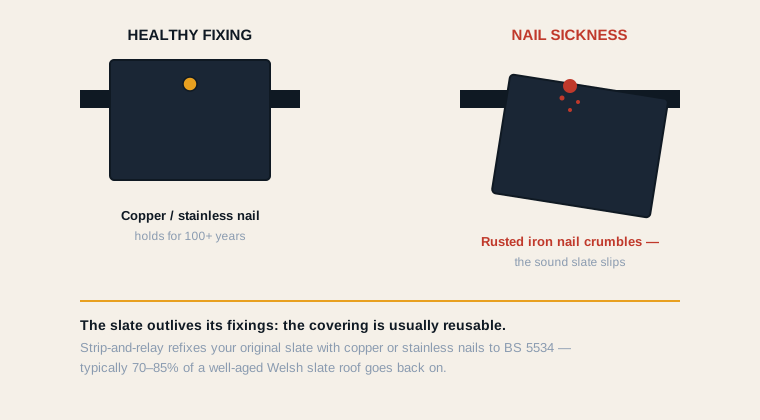
The 1960s–70s overspill estates — Popley, Winklebury, South Ham, Oakridge, Buckskin and Black Dam — account for over a third of the town's stock and were roofed with concrete interlocking tiles on iron nail fixings. Those fixings are now 50 to 65 years old and failing across whole slopes at once, because they were all installed within a few years of each other. Anything you read about roof maintenance needs filtering through that: on these roofs the covering is often sound while the thing holding it on is not.
The 1980s–2000s estates — Chineham, Kempshott, Lychpit, Hatch Warren and Beggarwood — have decades of life left in the covering. What fails there is mortar and detailing: ridge and verge bedding, and flashing junctions at dormers and extensions where volume housebuilders used mastic instead of lead. Those are cheap fixes caught early and expensive ones left alone.
Old Basing and the older pockets around the Top of Town are different again. Handmade clay and natural slate last 80 to 150 years, so a century-old roof may have half its life remaining. Conservation area requirements mean matched materials and lime mortar, which changes both the method and the cost.
Getting a Second Opinion
Roofing is one of the few trades where the customer cannot see the work being discussed, cannot watch it happen and cannot properly assess it afterwards. That asymmetry is why comparing quotes properly matters more here than almost anywhere else.
When you compare, look past the headline number. Does each quote include scaffold as its own line? Are materials named by manufacturer, or described vaguely as quality tiles? Is waste disposal included? Is there a written guarantee, and what does it actually cover? A quote £500 cheaper that omits scaffold, new battens and dry ridge is not cheaper — it is a smaller job wearing the same name.
Ask what happens if additional problems appear once work starts. A good answer describes a process: stop, photograph, discuss, agree the cost, continue. A vague answer means you may face charges you did not sign up for.
Where to Get Further Advice
The National Federation of Roofing Contractors publishes technical guidance for homeowners on material selection, standards compliance and choosing a contractor. Your local authority building control team can advise on when notification or approval is required. For conservation area and listed building work in Old Basing or Whitchurch, the Basingstoke and Deane Borough Council conservation officer is the definitive source on acceptable materials.
For anything specific to your own roof, an inspection is worth more than any amount of general reading. Call 0125 624 2410 — advice costs nothing and there is no obligation to book work.
Key Fact: Concrete interlocking tiles have a design life of 50–60 years according to the NFRC Technical Bulletin, with actual lifespan dependent on exposure, maintenance, and original specification. Source: NFRC Technical Bulletin — Concrete Tile Lifespan Guidance
The rule of thumb: if you are spending more than £500 per year on repeat roof repairs, or if a roofer tells you that more than 15% of your tiles need attention, it is time to consider a full replacement. On Basingstoke's estates, we typically see the tipping point at around 55–60 years, which means properties built in the mid-1960s are hitting it right now.
What a Replacement Involves
A full concrete tile replacement involves stripping all existing tiles, inspecting and replacing any damaged battens or underlay, checking the truss integrity (early 1960s trusses can develop lateral movement), and re-tiling with modern concrete interlocking tiles. We also fit dry ridge and dry verge systems as standard — eliminating the mortar that has been the weak point on these roofs for decades.
Cost and Timeline
A 3-bed semi re-roof in Basingstoke typically costs £5,000–£8,000 and takes 3–5 working days. Larger detached properties can be £8,000–£15,000. We offer competitive rates for multiple properties on the same terrace — if your neighbours are in the same situation, getting quotes together can reduce the per-property cost through shared scaffolding.
Local coverage: Roof replacement in Tadley · Roof replacement in Oakley
Getting a Second Opinion
Roofing is one of the few trades where the customer usually cannot see the work being discussed. That asymmetry is why getting a second opinion on any significant quote is sensible — not because most roofers are dishonest, but because specifications genuinely vary and comparing them is the only way to know what you are buying.
When comparing quotes, look past the headline figure. Does each quote include scaffold? Are materials named by manufacturer or described vaguely as "quality tiles"? Is waste disposal included? Is there a written guarantee, and what does it actually cover? A quote that is £500 cheaper but omits scaffold and dry ridge is not cheaper at all.
Questions Worth Asking
Ask what happens if additional problems are found once work starts. A good answer describes a process: stop, photograph, discuss, agree cost, then continue. A vague answer suggests you may face unexpected charges. Ask what guarantee is provided and request it in writing. Ask whether the guarantee transfers if you sell — a transferable guarantee is a genuine selling point.
Finally, ask for references from recent local work. Any roofer confident in their standards will provide them readily, and following up two or three takes ten minutes that could save you thousands.
Where to Get Further Advice
The National Federation of Roofing Contractors publishes technical guidance for homeowners covering material selection, standards compliance and choosing a contractor. Your local authority building control department can advise on when notification or approval is required. For conservation area and listed building work, the Basingstoke and Deane conservation officer is the definitive source on what materials will be acceptable.
For anything specific to your own roof, a professional inspection is worth more than any amount of general reading. Call 0125 624 2410 — advice costs nothing and there is no obligation to book work.
Call 0125 624 2410 for a free, no-obligation quote from a local Basingstoke roofer.
Related Reading
Roofing decisions rarely exist in isolation. A question about repair costs usually leads to a question about whether replacement makes more sense, which leads to material choices, which leads to what a good quote should contain. Our other guides cover each of these in the same detail as this one.
If you are working through a specific decision and want to talk it through rather than read about it, call 0125 624 2410. There is no charge for advice and no expectation that you will book anything. We would rather you made a well-informed decision — even if that decision is to use someone else — than an uninformed one.
How This Applies to Your Property
General guidance takes you only so far. The right answer for a 1960s system-built terrace in Popley is different from the right answer for a Victorian cottage in Old Basing or a 2000s detached in Beggarwood. Housing era, roof structure, exposure and existing condition all shape what is appropriate.
A free inspection resolves this in under an hour. We look at your actual roof, tell you what we find, and give you a written assessment you can act on or file for reference. No obligation either way.