A straight framework for deciding — including when replacement is oversell and a repair is genuinely the right answer. Written by roofers who quote both.
Tell us the job in 30 seconds. No pushy sales, no call-out fee.
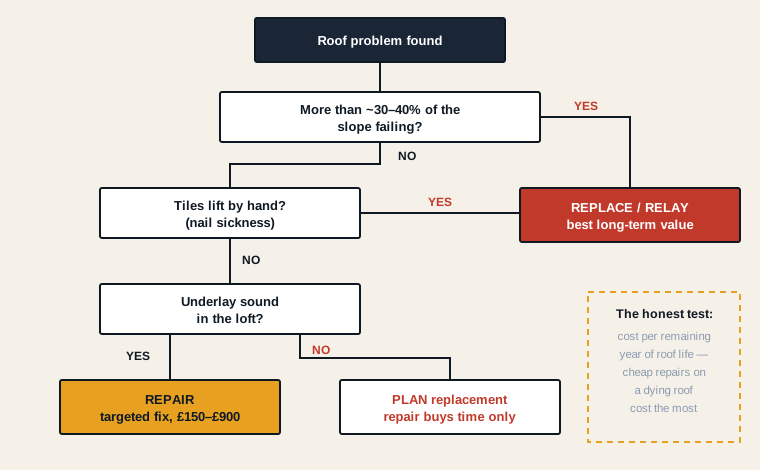
Repair when damage is isolated: a few tiles, one flashing, one valley, with the rest of the covering sound. Replace when failure is systemic — widespread nail sickness, eroded tiles across multiple slopes, or annual repair spend over £500 and rising. Once roughly 30% of the covering needs attention, replacement usually wins on cost-per-remaining-year.
✓ NFRC Registered
✓ Fully Insured
✓ 10 Year Guarantee
✓ Free Quotes
✓ No Hidden Costs
✓ Family Run Since 2003
Honest advice
The Decision in Four Questions
Most homeowners already have the information to make this call. It is a question of arranging it properly rather than gathering more.
Is the failure isolated or systemic? One spot is a repair. The same fault appearing across multiple slopes is systemic.
What is the fixing condition? Sound fixings with damaged tiles is a repair. Corroded fixings holding sound tiles is a replacement waiting to happen.
What have you spent in the last three years? Add it up honestly, including the emergency call-outs.
How long do you intend to stay? This changes the maths more than anything else on the list.
When replacement is not the answer: a sound covering with one failed detail does not need replacing, regardless of the roof's age. A 55-year-old roof with intact fixings and a cracked ridge needs the ridge fixing. We quote that repair and say so, because the alternative is selling a job that is not needed.
Repair-or-replace decision tree: extent of failure and fixing condition are the two branches that decide itLocal knowledge
The Answer by Basingstoke Housing Era
Basingstoke's housing splits into clear eras, and the right answer differs sharply between them.
1960s overspill — Popley Phase 1, South Ham, Oakridge, Black Dam
These are the roofs where replacement usually wins. Built between 1961 and 1970 with iron nail fixings that are now 55 to 65 years old, they typically show nail sickness across every slope simultaneously — because every nail is the same age and has weathered identically. Re-nailing individually costs £8 to £15 per tile; on a 1,200-tile roof that exceeds the cost of a full re-roof which also gives you new battens, new membrane and a 60-year warranty. If your Popley or South Ham roof has never been replaced, plan for it.
1970s — Winklebury, Buckskin
The intermediate case, and where the decision is genuinely finely balanced. Surface erosion is the marker here: the coloured coating wears off, exposing porous grey aggregate that absorbs water and cracks in frost. If erosion is patchy and confined to one elevation, targeted replacement of the worst tiles buys 5 to 10 years cheaply. If it is visible across the whole roof as patchy colour variation from ground level, the tiles have reached the end.
Almost always repair territory. These roofs are 30 to 45 years old with sound fixings. What fails is the mortar — ridges and verges — and the flashing details where volume housebuilders cut corners. Converting to dry ridge and re-flashing properly costs a fraction of replacement and resets those elements for the roof's remaining life.
2000s — Beggarwood, Hatch Warren later phases
Repair, without exception, unless there has been physical damage. These roofs have decades left. What they need is maintenance — gutter clearing, valley checks, flashing inspection at dormer junctions — not replacement.
Old Basing and period stock
A different calculation entirely. Handmade clay and natural slate last 80 to 150 years, so a 100-year-old clay roof may have half its life remaining. Individual slate and tile replacement using reclaimed matched stock is almost always right, and wholesale replacement of a sound period roof destroys character and value.
The process
How to Work It Out Yourself
1. Look from the pavement
Stand back and sight along each slope. Uneven tiles, gaps in the courses and dips in the roofline are all visible from the ground and all point toward systemic problems.
2. Check the loft on a dry day
Daylight through the tile courses means slipped tiles. Rust-coloured debris on the underlay means corroding nails. Brittle or torn underlay means the secondary barrier has gone.
3. Add up three years of repairs
Include the emergency call-outs. If the total is over £1,500 and rising year on year, you are funding a replacement in instalments without getting one.
4. Get a professional inspection
At £100 to £250 it settles the question with evidence rather than guesswork, and the fee is credited against any work booked.
5. Do the cost-per-year maths
Divide each option by the years it buys. A £600 repair lasting 4 years is £150/year. A £7,500 re-roof lasting 60 years is £125/year — and comes with a guarantee.
Timescales
How Long You Have to Decide
Situation
How long you can reasonably wait
Water entering a living space
Immediate — this is not a decision, it is an emergency
Water in the loft only, contained
Days, not weeks — timber damage accumulates
Slipped tiles, no ingress
Weeks — but before the next storm season
Widespread nail sickness, roof still watertight
1–2 years with monitoring, budget accordingly
Surface erosion, no active failure
3–5 years with annual inspection
Delay costs money in one specific way: water reaching battens and rafters turns a £7,000 re-tile into a £10,000+ structural repair. Everything above assumes the roof is currently keeping water out.
Access
What an Inspection Involves
A decision-grade inspection needs both the roof surface and the roof void. From the ground you cannot see fixing condition; from the loft hatch you cannot see the underlay beyond arm's reach.
On most Basingstoke housing this is ladder access plus loft entry, taking an hour or two with no scaffold needed. On three-storey properties and the Buckskin maisonette blocks a tower may be required, which we mention when booking rather than adding on the day. Where a pavement licence would be needed from Basingstoke and Deane Borough Council for anything beyond a ladder, we tell you before the visit.
Pricing
The Cost-Per-Remaining-Year Comparison
Option
Typical cost
Years bought / cost per year
Individual tile repair
£150–£280
2–5 years · £50–£100/yr
Ridge re-bed (mortar)
£280–£550
10–25 years · £25–£45/yr
Dry ridge conversion
£450–£900
Life of roof · £10–£20/yr
Single slope re-cover
£1,800–£4,500
50–60 years · £35–£80/yr
Full re-roof, 3-bed semi
£6,500–£11,500
60+ years · £110–£190/yr
Repeated annual patching
£500+/yr rising
1 year each time · £500+/yr
What moves the decision
How long you plan to stay — under three years changes the answer materially
Whether the underlay and battens have life left, which only a strip reveals for certain
Whether tiles are still available to match, a real constraint on discontinued profiles
Conservation constraints where material sourcing drives cost more than labour
Whether neighbours are re-roofing, since shared scaffold saves £400–£700
Worked example: A 1966 semi on Carpenters Down, Popley had spent £480, £620 and £390 on repairs across three years — £1,490 total, with tiles still slipping. A re-roof quoted at £7,400 works out at roughly £123 per year over its 60-year life against £497 per year on the recent pattern. Replacement was clearly right, and the homeowner had the evidence to see it.
No deposit on repairs under £500. Staged payments on re-roofs with nothing due before materials are on site. Inspection fees credited against any work booked. All prices include VAT.
Covering RG21, RG22, RG23, RG24 and surrounding postcodes.
Guarantee
What Each Option Comes With
Both routes carry our written 10-year workmanship guarantee, but what sits behind it differs.
Repair: 10-year workmanship guarantee on the repaired section specifically, not the surrounding roof.
Replacement: 10-year workmanship guarantee on the whole roof, plus manufacturer tile warranties of 15–30 years, plus a transferable record for when you sell.
Not covered either way: storm and impact damage, which is an insurance matter.
The transferability point matters more than people expect. A documented guaranteed roof removes a line of attack from a buyer's surveyor, and on Basingstoke's 1960s estates that is a live issue on every sale.
Key Fact: RICS guidance on residential stock condition notes that roof covering replacement is generally warranted where defects are widespread rather than localised, and cautions against wholesale replacement of historic coverings that retain substantial serviceable life. Source: RICS — Residential Stock Condition Guidance · BRE housing stock assessment methodology
Not sure which side you fall on? Free inspection and an honest answer, even when the answer is 'do nothing yet'.
Two things shift this decision more than any technical factor. The first is how long you are staying: if you are selling within two years, a documented repair plus disclosure often serves you better than funding a replacement the buyer benefits from. The second is whether your neighbours are doing work, because shared scaffold on Basingstoke's terraced and semi-detached streets saves £400 to £700 per property.
Weather matters less than people assume. Basingstoke's chalk position drains quickly and tile work continues year-round, so there is no seasonal reason to delay a decision you have already made.
FAQ
Frequently Asked Questions
Count the failure points. Isolated damage — a few tiles, one flashing, one valley — is a repair. Systemic failure across multiple slopes, especially nail sickness on 1960s–70s stock, means replacement. If more than roughly a third of the covering has failed, repairing tile-by-tile is money you will spend again.
A rule of thumb rather than a standard: once around 30% of the covering needs attention, the cost of repairing approaches the cost of replacing, and you get none of the 60-year lifespan. Below 30%, repair almost always wins on cost-per-remaining-year.
Concrete interlocking tiles are designed for 50 to 60 years. Basingstoke's overspill estates were roofed between 1961 and 1979, so most unreplaced estate roofs are now at or past that point. Age alone is not the trigger — fixing condition is.
Yes, and it happens. If your covering is sound and only the ridge or one valley has failed, replacement is not warranted. We quote the repair in that situation and say so plainly, because selling a £7,000 job to fix a £400 problem is how the trade gets its reputation.
Track it. If annual repair spend has passed about £500 and is rising, the cumulative cost over five years approaches a substantial share of a re-roof — and you still have an old roof at the end of it.
It rarely adds value pound-for-pound, but a failing roof actively subtracts value and can stall a sale entirely. A documented, guaranteed new roof removes a negotiating lever from the buyer's surveyor, which is usually worth more than the headline valuation effect.
Sometimes, and on a semi where only the rear slope has failed it can be the right answer. The caveat is that the slopes will then age differently and the newer one will outlive the older by decades, so it is a staged replacement rather than a saving.