Why the distinction matters more than the mould
Almost every landlord damp dispute turns on one question: is this a building defect or a lifestyle issue? Tenants say the roof leaks. Landlords say the tenant dries washing indoors and never opens a window. Both are sometimes right, and the mould looks broadly similar either way.
Getting the diagnosis right is not about winning an argument. It is about fixing the actual problem, because a dehumidifier will not stop a slipped tile and a new roof will not stop condensation from an unvented bathroom.
How to tell roof ingress from condensation
Roof ingress produces a defined patch with edges, often with a tidemark or staining ring. It correlates with rainfall and specifically with rain from a particular direction. It appears and then dries between weather events. It is frequently on a ceiling, at a wall head, or on a chimney breast.
Condensation produces diffuse surface dampness without clear edges, concentrated on cold surfaces — external wall corners, behind furniture, around window reveals, on cold bridges. It is worse in winter and worse overnight. It has no relationship to rainfall at all, which is the single most useful test.
The check that settles most cases: ask the tenant whether it gets worse after rain, or worse in cold weather with no rain. Roof ingress tracks rain. Condensation tracks temperature.
Where roof-sourced damp appears in Basingstoke's rental stock
On the 1960s–70s estates, the classic pattern is a bedroom ceiling stain that appears after heavy rain and fades over a few dry days. That is almost always nail sickness — a tile has slipped and wind-driven rain is getting onto sixty-year-old underlay that no longer sheds it. Popley Phase 1, South Ham, Oakridge and Black Dam are the streets we see it on most.
On properties with mature trees overhanging — Chineham along the Petty's Brook corridor, Oakley's woodland edge, Overton's riverside plots — the pattern is different. A blocked valley backs water above the tile lap and produces a stain that appears suddenly during heavy rain, often at a ceiling junction rather than in the middle of a room.
Damp on a chimney breast, typically upstairs first, is failed pointing, cracked flaunching or defective flashing letting water into the stack. It gets misdiagnosed as rising damp with some regularity, and a damp-proofing contractor will happily inject a course that does nothing at all for it.
Black Dam deserves a specific mention. The estate sits enclosed by the A339 and the railway in the most humid microclimate in Basingstoke. Roofs there dry more slowly and mould establishes faster in the roof void, so a defect that would be a slow problem elsewhere becomes a fast one here.
The condensation causes that are genuinely the building's fault
It is worth separating condensation from tenant behaviour honestly, because some condensation is a building defect and therefore your responsibility.
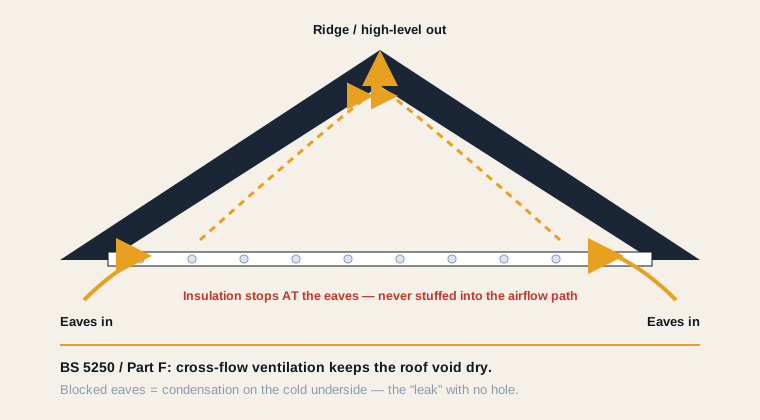
Blocked or absent eaves ventilation is the most common. Roof voids need airflow, and Building Regulations Approved Document F requires the equivalent of a continuous 10mm gap at eaves level on a pitched roof. That ventilation is routinely lost when soffits are replaced or capped without ventilated strips — a very common outcome on cheap roofline jobs across Basingstoke's estates in the 1990s and 2000s.
Where eaves ventilation has been blocked, warm moist air from the house accumulates in the roof void, condenses on the cold underside of the underlay, and drips back onto the insulation and ceiling below. The tenant reports damp patches on the bedroom ceiling. It looks exactly like a leak. It is a ventilation defect, and it is the landlord's to fix.
Cold bridging at the wall head and inadequate loft insulation coverage produce similar localised condensation and are similarly the building's responsibility.
Your obligations when a tenant reports mould
Under the Homes (Fitness for Human Habitation) Act 2018, the property must be fit for habitation throughout the tenancy, and damp and mould growth is one of the twenty-nine HHSRS hazards against which fitness is assessed. Tenants can bring a claim directly.
Awaab's Law, which sets fixed statutory timescales for investigating and remedying damp and mould, applies to registered social housing providers only at present. Its extension to the private rented sector sits in Phase 3 of the Renters' Rights Act roadmap and has no confirmed commencement date. You are not currently bound by those timescales — but you are bound by the 2018 Act, and a slow response to a reported hazard is difficult to defend under it.
The practical answer is the same either way: log the report with a date, inspect promptly, diagnose the cause properly rather than assuming lifestyle, and document everything.
What a proper diagnosis involves
A meaningful damp inspection covers the roof surface, the roof void and the affected internal area. From outside we check tiles, ridges, valleys, flashings and gutters for the specific defect that would produce damp in that position. From inside the loft we look for daylight, wet or brittle underlay, staining on timbers, blocked eaves ventilation and insulation coverage. Internally we look at where the damp sits, its pattern and its edges.
The output is a written report saying which it is and why, with dated photographs. That document does two jobs: it tells you what to fix, and it is the evidence if the tenant later claims the response was inadequate.
Remedies by cause
Roof ingress: fix the defect. Slipped tiles re-fixed, valley cleared and relined, flashing renewed in code 4 lead. Typically £150 to £900 depending on the fault, and it stops immediately.
Blocked eaves ventilation: replace soffits with ventilated equivalents or fit over-fascia vents. Usually £300 to £900 per elevation, and it resolves roof-void condensation permanently.
Genuine lifestyle condensation: extractor fan provision, trickle vents and heating advice. Worth documenting that you have addressed the building side first, because a tribunal will ask.
What does not work: painting over it, anti-mould paint alone, or treating a ventilation defect as a tenant education problem. All three come back.
Key Fact: Building Regulations Approved Document F requires roof void ventilation equivalent to a continuous 10mm gap at eaves level on pitched roofs — a requirement frequently lost when soffits are replaced or capped without ventilated strips, producing roof-void condensation that presents identically to a leak. Source: Building Regulations Approved Document F — Ventilation · Housing Health and Safety Rating System (HHSRS)
Landlord roof repairs and portfolio services →
Your legal obligations in full →
Book a documented roof inspection →
Call 0125 624 2410 — portfolio rates, documented reports and direct tenant liaison across Basingstoke.
Last reviewed: August 2026