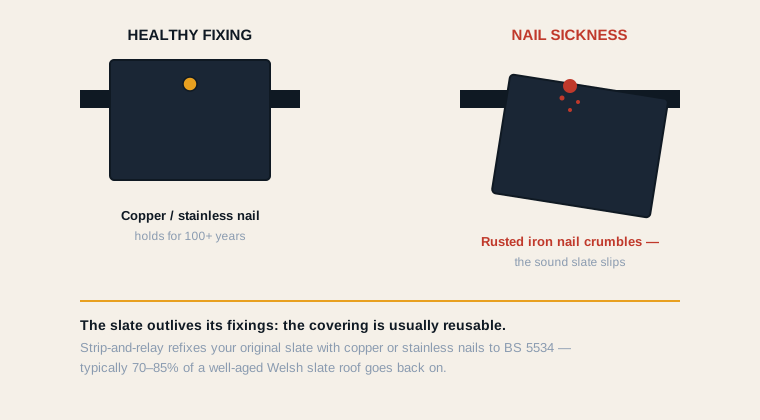
If you live on one of Basingstoke's 1960s overspill estates — Popley, Winklebury, South Ham, Oakridge, Buckskin, Black Dam — there is a high probability your roof has nail sickness. Here is what it is, how to spot it, and what to do about it.
What Is Nail Sickness?
Concrete interlocking tiles are held in place by nails driven through the tile's nailing hole into the timber batten beneath. In the 1960s, these nails were typically plain iron or mild steel. After 50–60 years of exposure to moisture — condensation in the roof space, rain tracking under tiles, and general humidity — these iron nails corrode. As they corrode, they lose diameter and grip. Eventually the tile is no longer held securely and can slip, lift, or blow off in wind.
How This Applies to Basingstoke Housing
General roofing advice only takes you so far, because the right answer depends heavily on what your roof is actually made of and when it went on. Basingstoke's housing splits into clear eras and each behaves differently.
The 1960s–70s overspill estates — Popley, Winklebury, South Ham, Oakridge, Buckskin and Black Dam — account for over a third of the town's stock and were roofed with concrete interlocking tiles on iron nail fixings. Those fixings are now 50 to 65 years old and failing across whole slopes at once, because they were all installed within a few years of each other. Anything you read about roof maintenance needs filtering through that: on these roofs the covering is often sound while the thing holding it on is not.
The 1980s–2000s estates — Chineham, Kempshott, Lychpit, Hatch Warren and Beggarwood — have decades of life left in the covering. What fails there is mortar and detailing: ridge and verge bedding, and flashing junctions at dormers and extensions where volume housebuilders used mastic instead of lead. Those are cheap fixes caught early and expensive ones left alone.
Old Basing and the older pockets around the Top of Town are different again. Handmade clay and natural slate last 80 to 150 years, so a century-old roof may have half its life remaining. Conservation area requirements mean matched materials and lime mortar, which changes both the method and the cost.
Getting a Second Opinion
Roofing is one of the few trades where the customer cannot see the work being discussed, cannot watch it happen and cannot properly assess it afterwards. That asymmetry is why comparing quotes properly matters more here than almost anywhere else.
When you compare, look past the headline number. Does each quote include scaffold as its own line? Are materials named by manufacturer, or described vaguely as quality tiles? Is waste disposal included? Is there a written guarantee, and what does it actually cover? A quote £500 cheaper that omits scaffold, new battens and dry ridge is not cheaper — it is a smaller job wearing the same name.
Ask what happens if additional problems appear once work starts. A good answer describes a process: stop, photograph, discuss, agree the cost, continue. A vague answer means you may face charges you did not sign up for.
Where to Get Further Advice
The National Federation of Roofing Contractors publishes technical guidance for homeowners on material selection, standards compliance and choosing a contractor. Your local authority building control team can advise on when notification or approval is required. For conservation area and listed building work in Old Basing or Whitchurch, the Basingstoke and Deane Borough Council conservation officer is the definitive source on acceptable materials.
For anything specific to your own roof, an inspection is worth more than any amount of general reading. Call 0125 624 2410 — advice costs nothing and there is no obligation to book work.
Key Fact: BS 5534:2014 now requires stainless steel or aluminium alloy fixings for all new roofing installations, replacing the iron and mild steel nails that cause nail sickness on pre-2000 housing. Source: BS 5534:2014 — Code of Practice for Slating and Tiling
Why Is It So Common in Basingstoke?
Simple maths. Basingstoke's population quadrupled in the 1960s through the London overspill programme. Tens of thousands of homes were built within the same decade, all using the same materials and techniques. The iron nails used across Popley, Winklebury, South Ham, Oakridge, Buckskin and Black Dam are all the same age, all exposed to the same conditions, and all corroding at roughly the same rate. It is not a question of if — it is a question of when.
How to Spot Nail Sickness
From the ground, look for tiles sitting unevenly — dipped or raised compared to their neighbours. Look for gaps between tile courses that were not there before. Check the garden and paths for tile fragments after wind. From inside the loft, you may see daylight through the tile courses where tiles have shifted. Crumbling rust-coloured debris on the underlay beneath the battens is a clear sign of corroding nails.
Repair or Replace?
If nail sickness is limited to one area — perhaps a more exposed slope — individual tiles can be re-nailed with stainless steel or aluminium nails. But if the problem is widespread, which it usually is on Basingstoke's estates because all nails are the same age, a full re-roof is the only permanent solution. Re-nailing every tile individually costs almost as much as a re-roof and does not address the battens and underlay that have also deteriorated over 60 years.
Local coverage: Roof repairs in Tadley · Roof repairs in Kingsclere · Roof replacement in Whitchurch
Getting a Second Opinion
Roofing is one of the few trades where the customer usually cannot see the work being discussed. That asymmetry is why getting a second opinion on any significant quote is sensible — not because most roofers are dishonest, but because specifications genuinely vary and comparing them is the only way to know what you are buying.
When comparing quotes, look past the headline figure. Does each quote include scaffold? Are materials named by manufacturer or described vaguely as "quality tiles"? Is waste disposal included? Is there a written guarantee, and what does it actually cover? A quote that is £500 cheaper but omits scaffold and dry ridge is not cheaper at all.
Questions Worth Asking
Ask what happens if additional problems are found once work starts. A good answer describes a process: stop, photograph, discuss, agree cost, then continue. A vague answer suggests you may face unexpected charges. Ask what guarantee is provided and request it in writing. Ask whether the guarantee transfers if you sell — a transferable guarantee is a genuine selling point.
Finally, ask for references from recent local work. Any roofer confident in their standards will provide them readily, and following up two or three takes ten minutes that could save you thousands.
Call 0125 624 2410 for a free, no-obligation quote from a local Basingstoke roofer.