Leadwork covering Popley and surrounding areas. We know the 1960s system-built terraces here — nail sickness on 60-year fixings, system-built flat sections.
Tell us the job in 30 seconds. No pushy sales, no call-out fee.
📞 Call Now: 0125 624 2410Lead fails at the junctions first, and it fails where movement is greatest. Knowing which detail has gone is the difference between a targeted repair and re-dressing an entire elevation.
When it is not the answer: If the existing lead is sound and only the pointing above it has failed, repointing alone fixes it. Re-dressing serviceable lead is unnecessary cost. Read the full guide.
Leadwork on Popley's 1960s system-built terraces addresses the critical waterproofing at every junction where different surfaces meet. The specific challenge here is nail sickness on 60-year fixings, system-built flat sections. Properties along Carpenters Down, Faraday Road, Popley Way may have original lead flashings that have fatigued, mastic sealant that was never adequate, or mortar fillets that should have been lead from the start. We strip and re-dress with minimum code 4 lead for permanent weatherproofing.
Popley's 1960s system-built terraces along Carpenters Down, Faraday Road, Popley Way present specific challenges: nail sickness on 60-year fixings, system-built flat sections. Our approach is tailored to these conditions — not a generic specification applied regardless of location.
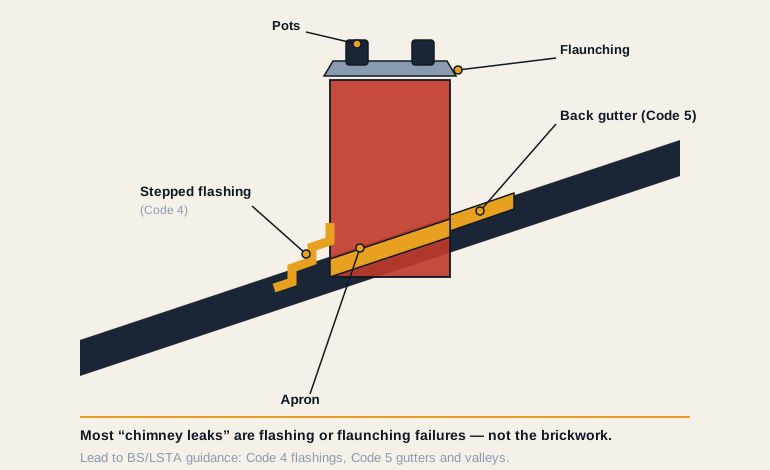
All our leadwork follows the Lead Sheet Association code of practice. We use code 4 lead (1.80mm) minimum for flashings and code 5 (2.24mm) for valleys and heritage applications. Lead is cut, dressed and bossed on site to fit the exact geometry of your roof junction — never pre-formed off site and forced into position. Step flashings are cut individually for each tile course, turned into chased mortar joints, and secured with lead wedges before pointing.
Apron flashings are dressed over the tiles below with adequate lap and dressed tight to the wall above with a minimum 75mm upstand. Every joint accounts for thermal movement — lead expands and contracts significantly, and work that ignores this cracks within a few years regardless of material quality.
Every shortcut in leadwork becomes a future leak. Mastic sealant instead of lead lasts around ten years, not fifty. Self-adhesive lead-effect tape lifts under thermal cycling. Mortar fillets instead of proper flashings crack within five years on exposed positions. Code 3 lead, still used by some contractors to save material cost, fatigues far faster than code 4 and has no place in a permanent repair. the 1960s system-built construction means water can track along unconventional routes between the building frame and roof covering.
Period properties require heavier gauge lead and traditional techniques. We use code 5 and code 6 for heritage applications and apply patination oil so new lead weathers to match surrounding original work rather than staining the masonry beneath. Where conservation area or listed building consent applies, we discuss specifications with the conservation officer before starting work.
All work in Popley carries a written 10-year workmanship guarantee. That guarantee is transferable if you sell the property, which is a genuine asset when marketing a house — buyers and their surveyors take a documented, guaranteed roof considerably more seriously than an undocumented one.
The guarantee covers our workmanship. Materials carry their own manufacturer warranties, typically 15–30 years for tiles and 20–25 years for flat roof membranes. We register these on your behalf where registration is required and pass the documentation to you on completion.
Call us. We return, inspect, and put it right at no cost if it falls within the guarantee. We do not argue about whether a fault is workmanship or materials — we resolve it first and sort out the attribution with the supplier afterwards. That is what a guarantee should mean and it is why we put ours in writing.
£300–£1,200. Free quotes. Call 0125 624 2410.
Back to: Roofers Popley → · Leadwork Basingstoke →
Lead does not fail uniformly. The first failures appear where movement is greatest: at the top of chimney back gutters, along the fold lines of step flashings, and at the head of valley linings. These are the points that flex most as temperature changes through the day and across the seasons.
South and west-facing elevations fail sooner than north and east because they experience greater temperature swings — heated by direct afternoon sun, then cooling rapidly overnight. On Popley properties we inspect these elevations first, because that is where problems start and where early intervention prevents a full flashing renewal.
Four steps from first call to completed work. No call-out fee, no obligation, and a written quote before anything starts.
We inspect all lead flashings, valleys, and junctions on your Popley roof from ladder access. We identify fatigue cracks, lifted sections, failed mastic, and mortar fillets that should be lead.
Your quote specifies the lead code, the junctions to be addressed, scaffold requirements, and total cost. We explain why proper lead is worth the investment over sealant or lead substitute.
Old lead or mastic stripped. New lead cut, dressed and bossed on site to fit the exact geometry of each junction. Step flashings chased into mortar joints. Aprons dressed over tiles.
Every junction tested, completed work photographed, site cleaned. You receive a 10-year guarantee on leadwork specified to last 50+ years.
Ready to start? Call 0125 624 2410 for your free survey.
Chimney flashings, abutments, valleys and dormer detail all checked, with the failure points photographed.
Lead code specified for the application — code 4 minimum for flashings, code 5 for valleys and heritage work — and priced with access.
Old lead, mastic or lead substitute removed entirely. Mortar joints raked out ready to receive proper chased flashing.
Lead cut and bossed to the actual geometry of your roof, stepped into the joints, wedged and pointed. Never pre-formed and forced to fit.
Water tested at the junction, photographed, and covered by the workmanship guarantee.
| Job | Typical duration |
|---|---|
| Chimney apron only | Half a day |
| Full chimney flashing set | 1 day |
| Dormer re-flash | 1–2 days |
| Valley relining | 1–2 days |
| Heritage leadwork | Quoted per specification |
Lead can be dressed in most conditions, but pointing the chased joints needs a dry window — that step waits for suitable weather.
Leadwork is precision work needing stable standing time, so access is specified accordingly. Scaffold is specified for: chimney flashings, dormer junctions and valley work — anywhere the work needs both hands and a stable platform - always itemised in your written quote, never a hidden extra, and we arrange it.
Popley Phase 1 terraces are set back behind shared parking courts, so scaffold often needs a short carry from the nearest hard standing. Phase 2 at Marnel Park has driveway access throughout. Pavement scaffold and skip permits go through Basingstoke and Deane Borough Council; allow a few working days on streets like Carpenters Down, Faraday Road, Priestley Road where space is tight.
| Job | Typical range | Notes |
|---|---|---|
| Chimney apron only | £180–£380 | Single face |
| Full chimney flashing set | £320–£700 | Soakers, steps, apron and back gutter |
| Dormer re-flash | £400–£800 | Stripping mastic or lead substitute |
| Valley relining | £450–£900 | Code 5 lead, correct laps and splash guards |
| Heritage leadwork | Per specification | Code 5–6 with patination oil |
| Abutment flashing per metre | £70–£140 | Roof-to-wall junctions |
Worked example: Full chimney flashing set in code 4 lead on a semi on Douro Close, Brighton Hill, replacing fatigued original lead on the sun-exposed south face: £620 including scaffold, one day on site.
No deposit on leadwork under £500. Larger jobs take a 10 to 20% deposit covering lead and scaffold, balance on completion. All prices include VAT.
Covering RG24 and surrounding postcodes.
Our 10-year workmanship guarantee applies. Properly specified code 4 lead has a service life of 50 to 60 years, and code 5 considerably longer.
If a fault appears in covered work, we come back and put it right. No quibbling, no re-charge.
Quiet, precise work with minimal debris. Some hammering while lead is bossed to shape, but nothing like a strip or re-roof. You do not need to stay home for external work - we just need power and access agreed in advance.
Lead dressing continues in most weather. Mortar pointing around chased flashings needs dry conditions above about 5°C. The open northern estates catch wind off the Loddon valley, so tiling pauses earlier on gusty days than it does in sheltered Basingstoke.
"Chimney flashing had split — decades of thermal cycling. New code 4 lead properly stepped into the brickwork. Watertight from day one."
"Valley relining — the old lead was paper thin and leaking at every lap. New code 5 lead with splash guards. Proper job."
"Dormer flashing was mastic from the original build. They stripped it and fitted proper lead step flashing. Should have been done like this originally."
Leadwork in Popley typically costs £300–£1,200. We provide free quotes after inspecting your specific property.
Yes. Popley is within our core coverage area. We work here regularly and understand the 1960s system-built terraces that make up the neighbourhood.
The main issue in Popley is nail sickness on 60-year fixings, system-built flat sections. We tailor our leadwork approach to these specific conditions.
Popley is within our Basingstoke coverage area. For scheduled work we typically book within 1–2 weeks. For emergencies, same-day response.
Code 4 lead: 50–60 years. Code 5: 80–100 years. Original code 3 on 1960s estates is now reaching end of life. Mastic substitute: 10–20 years maximum.
Not for long-term waterproofing. Mastic is a temporary measure with 10–20 year life. We always recommend proper lead for permanent repairs.
Yes. Code 5 and code 6 lead with patination oil for heritage applications. We understand conservation officer requirements.
Look for gaps between lead and wall, lifted or kinked sections, visible cracks along fold lines, and damp appearing internally near chimney breasts or wall-roof junctions.
Sealant is a temporary measure with a ten-year life at best. Proper lead lasts 50 years or more. On a permanent repair, lead is the only sensible specification.
Chimney back gutters, step flashing fold lines, and valley heads — the points that flex most with temperature change. South and west elevations fail before north and east.
Yes. The 10-year workmanship guarantee transfers to a new owner, which is a genuine selling point when marketing the property.
Our workmanship on the work carried out. Materials carry separate manufacturer warranties which we register on your behalf and hand over on completion.
No call-out fees. No obligation. Call a local Popley roofer now.
0125 624 2410Last updated: August 2026