Leadwork in South Ham
Leadwork Covering South Ham
Leadwork on South Ham's 1960s system-built with flat sections addresses the critical waterproofing at every junction where different surfaces meet. The specific challenge here is integral flat roof sections on non-traditional construction. Properties along Crossborough Hill, Western Way, Doggett Road may have original lead flashings that have fatigued, mastic sealant that was never adequate, or mortar fillets that should have been lead from the start. We strip and re-dress with minimum code 4 lead for permanent weatherproofing.
Why South Ham Needs Specialist Leadwork
South Ham's 1960s system-built with flat sections along Crossborough Hill, Western Way, Doggett Road present specific challenges: integral flat roof sections on non-traditional construction. Our approach is tailored to these conditions — not a generic specification applied regardless of location.
How We Work With Lead in South Ham
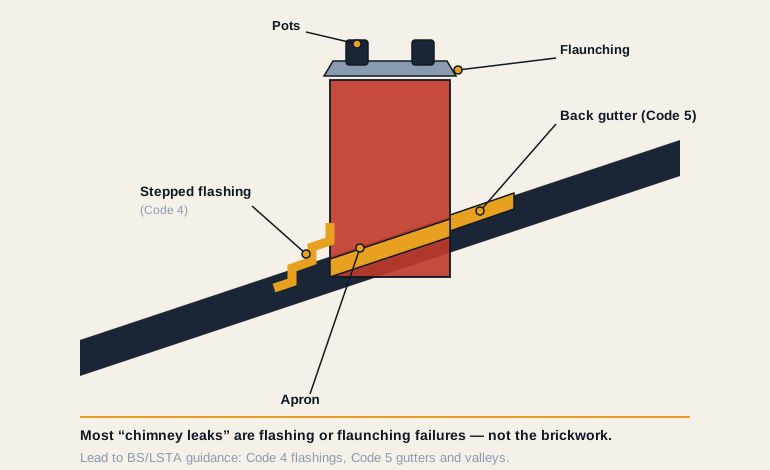
All our leadwork follows the Lead Sheet Association code of practice. We use code 4 lead (1.80mm) minimum for flashings and code 5 (2.24mm) for valleys and heritage applications. Lead is cut, dressed and bossed on site to fit the exact geometry of your roof junction — never pre-formed off site and forced into position. Step flashings are cut individually for each tile course, turned into chased mortar joints, and secured with lead wedges before pointing.
Apron flashings are dressed over the tiles below with adequate lap and dressed tight to the wall above with a minimum 75mm upstand. Every joint accounts for thermal movement — lead expands and contracts significantly, and work that ignores this cracks within a few years regardless of material quality.
Why Lead Code and Technique Matter
Every shortcut in leadwork becomes a future leak. Mastic sealant instead of lead lasts around ten years, not fifty. Self-adhesive lead-effect tape lifts under thermal cycling. Mortar fillets instead of proper flashings crack within five years on exposed positions. Code 3 lead, still used by some contractors to save material cost, fatigues far faster than code 4 and has no place in a permanent repair. the non-traditional system-built construction integrates flat and pitched sections in ways conventional detailing does not cover.
Heritage Leadwork
Period properties require heavier gauge lead and traditional techniques. We use code 5 and code 6 for heritage applications and apply patination oil so new lead weathers to match surrounding original work rather than staining the masonry beneath. Where conservation area or listed building consent applies, we discuss specifications with the conservation officer before starting work.
Guarantees and Aftercare in South Ham
All work in South Ham carries a written 10-year workmanship guarantee. That guarantee is transferable if you sell the property, which is a genuine asset when marketing a house — buyers and their surveyors take a documented, guaranteed roof considerably more seriously than an undocumented one.
The guarantee covers our workmanship. Materials carry their own manufacturer warranties, typically 15–30 years for tiles and 20–25 years for flat roof membranes. We register these on your behalf where registration is required and pass the documentation to you on completion.
What Happens If Something Goes Wrong
Call us. We return, inspect, and put it right at no cost if it falls within the guarantee. We do not argue about whether a fault is workmanship or materials — we resolve it first and sort out the attribution with the supplier afterwards. That is what a guarantee should mean and it is why we put ours in writing.
Leadwork in South Ham
£300–£1,200. Free quotes. Call 0125 624 2410.
Back to: Roofers South Ham → · Leadwork Basingstoke →
Where Lead Fails First
Lead does not fail uniformly. The first failures appear where movement is greatest: at the top of chimney back gutters, along the fold lines of step flashings, and at the head of valley linings. These are the points that flex most as temperature changes through the day and across the seasons.
South and west-facing elevations fail sooner than north and east because they experience greater temperature swings — heated by direct afternoon sun, then cooling rapidly overnight. On South Ham properties we inspect these elevations first, because that is where problems start and where early intervention prevents a full flashing renewal.