Chimney Repairs in Whitchurch
Chimney Repairs Covering Whitchurch
Historic market town with Georgian and Victorian properties along London Street and Bell Street. Handmade clay tiles and Welsh slate on period stock. Post-war estates on the southern fringe with concrete interlocking tiles. Test Valley conservation area constraints on the town centre.
Chimney Repairs Challenges in Whitchurch
Slate delamination on Victorian properties along London Street. Clay tile matching difficulties in the conservation area — planners require like-for-like replacements. Chimney stack repointing on Georgian townhouses exposed to the westerly Test Valley weather.
Why Whitchurch Specifically Matters for Chimney Repairs
Whitchurch sits in the Test Valley, one of Hampshire's most significant chalk river corridors. The valley position creates higher humidity than the Basingstoke plateau, and the River Test's water meadows produce ground-level mists that keep roof surfaces damp well into mid-morning during autumn and winter. For chimney repairs work, this creates specific challenges that differ from sheltered Basingstoke sites.
Whitchurch's housing is predominantly mixed — Georgian and Victorian core, post-war fringes stock, with a conservation area covering the historic centre along London Street and Bell Street. Period properties use handmade clay tiles and Welsh slate that require heritage-sensitive repair. Post-war estates on the southern fringe have standard concrete tiles. Conservation area constraints mean all visible roof work on the historic centre must use like-for-like materials approved by Test Valley Borough Council planning department. Machine-made tiles and synthetic slate are not acceptable.
Lime Mortar Chimney Work in Whitchurch
The Georgian and Victorian chimneys in Whitchurch's conservation area were built with lime mortar and must be repointed with lime — not cement. Cement mortar traps moisture in soft old brickwork, causing the brick faces to spall and deteriorate. Lime mortar breathes with the building, allowing moisture to migrate naturally through the joints rather than through the brick face. We mix and apply lime mortar to heritage standards on all Whitchurch conservation area chimney work.
Tall Chimney Stacks in the Test Valley
Whitchurch's period properties often have taller chimney stacks than modern housing — reflecting the deeper flue requirements of original open fire designs. These tall stacks are more exposed to wind and require scaffold access for safe working. We include scaffold in all Whitchurch chimney quotes and never attempt chimney work from ladders on tall period stacks.
Chimney Repairs Cost in Whitchurch
£150–£800+. Free, no-obligation quotes. Call 0125 624 2410.
How We Inspect Chimneys in Whitchurch
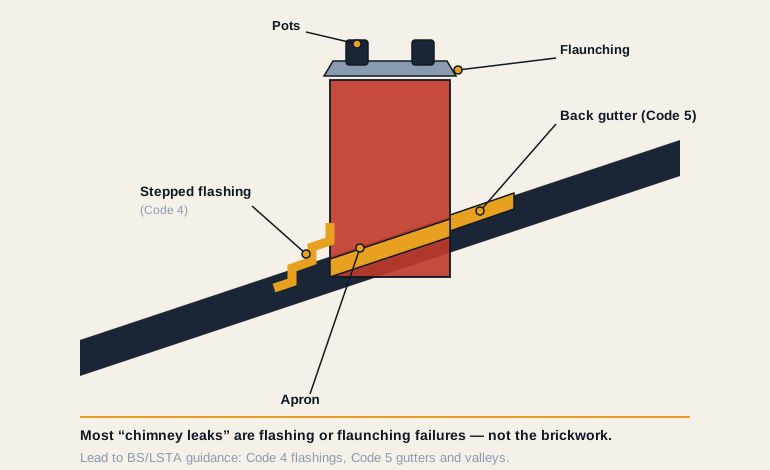
Chimney problems are often invisible from the ground. We inspect from scaffold or ladder access — checking every mortar joint, the condition of the flaunching around pots, the state of lead flashings at the roof junction, and the brickwork itself for frost damage, sulphate attack, or structural movement. Inside, we check the chimney breast walls for damp staining that indicates water tracking down through failed pointing or flashings.
Many chimney problems in Whitchurch are caused by multiple small failures rather than a single dramatic one. A combination of softening mortar, hairline flashing cracks, and porous brickwork can produce persistent damp that no single repair addresses. Our inspection identifies all contributing factors so the repair addresses the complete problem — not just the most obvious symptom.
Mortar Selection for Whitchurch Chimney Repairs
Not all mortar is the same, and using the wrong type causes more damage than it prevents. Modern cement mortar is too rigid and impermeable for older chimneys built with lime mortar — it traps moisture in the brickwork and causes frost spalling. We use lime putty mortar on pre-1920s chimneys and flexible cement mortar on post-war stacks. The correct choice depends on the original construction — and on Whitchurch's specific exposure conditions.
The processFrom First Call to Sign-Off
1. Free inspection from safe access
Every mortar joint, the flaunching, the pots and the flashing checked, plus the chimney breast internally to trace where water is actually entering.
2. Written report and quote
Photographs of what we found, with the mortar specification chosen for your stack's age — flexible cement on post-war brick, lime putty on anything pre-1920.
3. Scaffold
Safe chimney work needs scaffold, not ladders. It is the largest single cost and we itemise it separately so you can see it.
4. The repair
Repointing, flashing renewal, flaunching or pot work — combined where sensible so one scaffold erection covers everything.
5. Sign-off
Work photographed from the scaffold before it comes down, site cleared, guarantee issued.
Access, Scaffolding & Permits in Whitchurch
Chimney work requires scaffold in effectively all cases. Scaffold is specified for: every chimney job — working from a ladder at stack height makes proper raking out and consistent joint filling impossible - always itemised in your written quote, never a hidden extra, and we arrange it.
Whitchurch's conservation-area centre has narrow frontages directly onto the pavement — scaffold licences are the norm rather than the exception on London Street and Bell Street. Pavement scaffold and skip permits go through Basingstoke and Deane Borough Council; allow a few working days on streets like London Street, Bell Street, Winchester Road where space is tight.