Moss holds water against tiles, blocks valleys, lifts flashings and accelerates roof deterioration. Across Basingstoke's estates — particularly sheltered areas like Black Dam and shaded slopes in Chineham — moss growth is one of the most common roofing problems we treat.
Tell us the job in 30 seconds. No pushy sales, no call-out fee.
Moss is not only cosmetic. It holds water against the tile surface, blocks valleys and lifts flashing edges — but on a roof that is already failing, clearing it is treating a symptom.
Green growth visible across a north or east-facing slope
Moss fragments collecting in the gutters after wind or rain
A valley that looks green rather than grey when viewed from an upstairs window
Tiles lifting slightly at the tail where growth has forced beneath them
Regrowth appearing within a year of the last clearing
When it is not the answer: If the tiles beneath are eroded to exposed aggregate, clearing moss buys time but the surface will re-colonise fast. On those roofs replacement is the honest recommendation. Read the full guide.
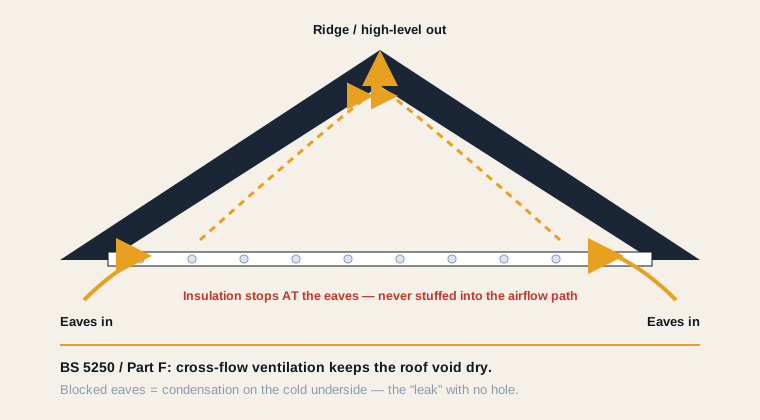
Roof void ventilation paths: eaves, ridge and cross-flow
Moss is not just cosmetic. On concrete interlocking tiles — the dominant roofing material across Basingstoke's overspill estates — moss roots penetrate the tile surface, accelerating erosion and making tiles more porous. Porous tiles absorb water, become heavier, and are more vulnerable to frost cracking. Left untreated, heavy moss growth can reduce a concrete tile roof's remaining life by 10–15 years.
The problem is worst on north-facing slopes that get less direct sunlight, and on estates with mature tree canopy that retains moisture. Black Dam's enclosed position creates a humid microclimate where moss colonises faster than anywhere else in Basingstoke. Chineham and Lychpit's mature garden trees shade large sections of roof. Even newer estates like Beggarwood are now developing moss on their north slopes as the surrounding planting matures.
Our Moss Removal Process
We clear moss manually — no pressure washing, which damages concrete tile surfaces and forces water under laps. Every tile is scraped clean, loose material is brushed into the gutter line and removed, and valleys are cleared completely. We then apply a professional biocide treatment that kills remaining spores and inhibits regrowth for 2–3 years.
Prevention Options
For properties with recurring moss problems, we fit copper or zinc ridge strips. Rainwater washing over these metal strips carries trace amounts of copper or zinc oxide down the roof slope, creating conditions hostile to moss and algae. This significantly reduces the frequency of manual clearing needed.
When Moss Removal Is Not Enough
If concrete tiles have eroded to the point where the aggregate is exposed and the surface is permanently porous, moss removal buys time but does not solve the underlying problem. On these roofs — common across Popley, Winklebury and Buckskin — replacement is the more cost-effective long-term solution. We will give you an honest assessment.
Moss Removal Costs in Basingstoke
3-bed terrace: £200–£350. Semi-detached: £250–£400. Detached: £350–£550. Includes biocide treatment. Copper strip fitting from £150 extra. Call 0125 624 2410 for a free quote.
Moss needs three things: moisture, shade, and a surface it can grip. North and east-facing slopes get the least direct sun, so surface water lingers and moss establishes first. Overhanging trees compound this by blocking what sunlight there is and dropping organic matter that holds moisture against the tiles. Concrete tiles are more vulnerable than clay or slate because their surface is microscopically porous even when new, and becomes progressively more so as the coating wears.
Understanding this pattern means we can predict where moss will return and target prevention accordingly, rather than clearing the whole roof and hoping. On Basingstoke properties we assess each slope separately and recommend treatment proportionate to the actual risk.
The Process
How to Get Moss Removal in Basingstoke
Four steps from first call to completed work. No call-out fee, no obligation, and a written quote before anything starts.
1
Free Roof Assessment
We inspect your Basingstoke roof to assess moss coverage, tile condition beneath the moss, and whether clearing alone is sufficient or whether tiles need replacement.
2
Written Quote
You receive a quote for manual clearing, biocide treatment, and optional copper strip fitting to prevent regrowth. No pressure washing — ever.
3
Manual Clearing and Treatment
Every tile scraped clean by hand from ridge to eaves. Valleys cleared completely. Biocide applied across the full treated area. Copper strips fitted if specified.
4
Clean Roof with Prevention
Moss cleared, surface treated, tiles re-seated where disturbed. You receive maintenance guidance on when to re-treat based on your Basingstoke property's specific exposure and shading conditions.
Ready to start? Call 0125 624 2410 for your free survey.
The process
From First Call to Sign-Off
1. Free assessment
We check moss coverage and, more importantly, the condition of the tiles beneath it. That determines whether clearing is worth your money.
2. Quote
Manual clearing and biocide treatment, with copper or zinc strip fitting quoted separately as optional prevention.
3. Manual clearing
Every tile scraped by hand from ridge downward. We never pressure wash — it strips the tile surface and forces water under the laps.
4. Valleys and gutters
Valleys cleared completely and checked for cracked lining underneath, then all debris bagged and removed from site.
5. Biocide and prevention
Professional biocide across the treated area, and copper strips fitted where you want the moss-free period extended.
Timescales
Typical Timescales
Job
Typical duration
Terrace roof
2–4 hours
Semi-detached
Half a day
Detached
1 day
Copper strip fitting
+2 hours
Biocide treatment
Included, same visit
Biocide needs a dry spell after application to work properly, so we schedule treatment against the forecast rather than applying it before rain.
Access
Access, Scaffolding & Permits in Basingstoke
Moss clearing runs from roof ladders on most Basingstoke housing. Scaffold is specified for: steep pitches, three-storey elevations, and any roof too fragile to take a roof ladder safely - always itemised in your written quote, never a hidden extra, and we arrange it.
Most Basingstoke estate housing has generous verges and driveway space, so scaffold and skips drop straight onto private ground. The older streets around the Top of Town are the exception, with narrow frontages and controlled on-street parking. Pavement scaffold and skip permits go through Basingstoke and Deane Borough Council; allow a few working days on streets like Wote Street, Church Street, New Street where space is tight.
Pricing
What Moss Removal Costs in Basingstoke
Job
Typical range
Notes
Terrace roof
£200–£350
Manual clearing plus biocide
Semi-detached
£250–£400
The most common job
Detached
£350–£550
Larger area, more valleys
Copper strip fitting
£150–£300
Extends the moss-free period to 5–7 years
Gutter clear add-on
£80–£150
Usually needed at the same time
Biocide treatment only
£120–£220
Where clearing is not yet required
What moves the price
Roof area and how many slopes are affected
Severity of colonisation and whether valleys are blocked
Aspect — north and east-facing slopes carry heavier growth
Whether prevention strips are fitted at the same time
Access and pitch, which determine ladder versus scaffold
Worked example: Full clearing, biocide and copper ridge strips on a semi on Essex Road, Black Dam, where the enclosed microclimate drives fast regrowth — £520 including VAT in a day.
No deposit on moss removal — payment on completion once you have seen the finished roof. All prices include VAT.
Covering RG21, RG22, RG23, RG24 and surrounding postcodes.
Guarantee
The Guarantee in Plain Terms
We guarantee the clearing work and the correct application of treatment. Moss regrowth itself is a natural process, not a defect — copper strips are the honest long-term answer.
Covered: workmanship for 10 years, in writing, transferable if you sell.
On top: manufacturer warranties on materials (terms vary by product).
Not covered: storm or impact damage - that is an insurance matter, and we will document it for your claim.
If a fault appears in covered work, we come back and put it right. No quibbling, no re-charge.
Good to know
Living Around the Work
Moss debris falls into gutters and onto the ground below. We sheet planting, clear the gutters as part of the job, and bag everything off site. You do not need to stay home for external work - we just need power and access agreed in advance.
Clearing runs year-round. Biocide application needs a dry window, and spring is the most effective time as moss is actively growing. Basingstoke sits on chalk downland at around 80 metres, so drying is quick after rain but frost nights run longer than the Hampshire coast.
Customer Reviews
What Basingstoke Homeowners Say
★★★★★
"Back slope was completely green — hadn't been touched in 15 years. They cleared the lot by hand, treated the surface, and fitted copper strips along the ridge. Looks brand new and the moss hasn't come back."
Stan H. · Black Dam, Basingstoke
★★★★★
"Moss was blocking both valleys on our Chineham detached. Water was overflowing into the fascia. Cleared, treated, valley guards fitted. First winter without a problem in years."
Fiona E. · Chineham, Basingstoke
★★★★★
"They were honest — said the tiles on our Winklebury semi were too far gone for moss removal to make a real difference. Quoted a re-roof instead. Appreciated the straight talk."
Gill T. · Winklebury, Basingstoke
FAQ
Frequently Asked Questions
A typical 3-bed semi costs £250–£400 including manual clearing and biocide treatment. Larger detached properties £350–£550. Copper strip fitting to prevent regrowth is from £150 extra.
No. We never pressure wash roofs. High-pressure water damages the surface of concrete tiles, forces water under tile laps, and can dislodge mortar on ridges and verges. We clear moss manually and treat with biocide.
On sheltered north-facing slopes, every 2–3 years without prevention treatment. With copper or zinc ridge strips fitted, moss regrowth slows significantly and you may only need clearing every 5–7 years.
Yes. Moss holds water against tiles, accelerates surface erosion on concrete, blocks valleys causing leaks, and can lift flashings. On Basingstoke's 1960s estate housing where tiles are already aging, moss significantly shortens remaining roof life.
Black Dam's enclosed microclimate is the worst. Chineham and Lychpit have heavy tree canopy that shades roofs. North-facing slopes on any estate are vulnerable. Even newer estates like Beggarwood are developing moss as planting matures.
Copper or zinc ridge strips are the most effective prevention. Rainwater carries trace metal oxide down the roof slope, inhibiting moss and algae growth. Combined with biocide treatment after clearing, this gives the longest moss-free period.
If the leak is caused by blocked valleys or displaced tiles from moss growth, clearing the moss fixes the root cause. If tiles are eroded and porous from years of moss damage, clearing helps but replacement may be needed for a permanent solution.